by Frederick M. Wiseman and the Elnu Abenaki Tribe
Introduction
The snow snake game is played throughout North America wherever there is enough snow to warrant it. Most Native American snow snakes are quite long, from four to as long as ten feet, often thrown down a special lane made in the snow. The Abenaki game and snow snakes are somewhat different from the general pattern.

The Elnu Abenakis’ competition Snow snakes
Snow snakes are recorded by Euroamerican observers from the Passamaquoddy and Penobscot people and the Abenakis at Norridgewok, Maine. Most of the snow snakes of Wôbanakik are shorter than those of the Haudenosaunee (Iroquois) or more western native people. Except for an exceptional five to seven foot example from the Passamaquoddy people, and a short Penobscot 14 1/2″ long example, most snow snakes are 18″-24″ long. Among the numerous shapes are two named varieties, the spoon mouth (called mquon in Passamaquoddy) and snake head (called atosis in Passamaquoddy). Some have a pewter or lead weight cast into the head. ‘
These are fine wood shop projects. Make the snakes from maple, birch or ash about 7/7″ – 1″ wide by 1/2″- 5/8″ thick. Carving is optional but does not improve the distance of the throw. I have made mine longer, about 3 feet long, so they will be more competitive with
other native Nations’ snowsnakes, but the design is up to you.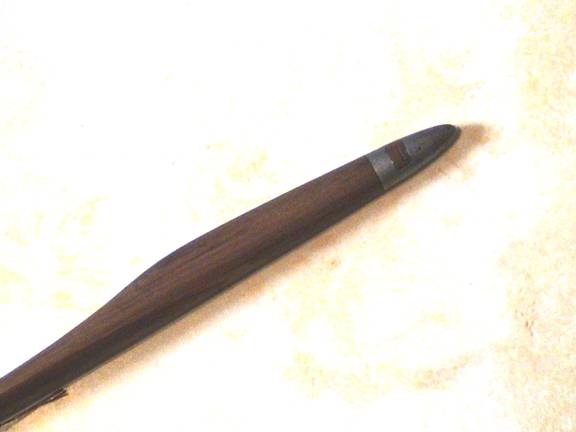 Original 19th century Pewter-headed competition Snow snake
Making the Snowsnake
The design presented here is adapted from published Maine examples. The snowsnakes are very easy projects, using dimensional lumber and requiring but little carving expertise.
Bill of materials
1. Hardwood lumber 1″ X 1/2″ X 40″.
Instructions
1. With a pocketknife, whittle the snowsnake head to the shape shown in the photograph above.
2. With a hand plane carefully plane the rest ot the snowsnake to a triangular cross-section.
3. Taper the end and sand the snowsnake.
4. If you wish, carve in the head design and body designs with a small gouge.
5. Final sand, stain and varnish the snowsnake.
Calling to play:
If someone is interested in playing snow snakes, he goes through the village crying the name of the snow snake game in the local dialect. People who are interested join him, bringing their snow snakes. The group proceeds to a place with a hard flat crust of snow. The snow snakes glide best on such a surface.
The Snowsnake course
Often contestants will make a straight groove in the snow by dragging a 3″ diameter log through the snow. Occasionally, the course will be raised by piling a long straight (or sometimes slightly curving) linear mound of snow. The groove can then be made on top of the mound. Alternatively, the mound can taper to ground level.
Raised Abenaki Snow snake course, showing slight curve
The Play
Each player advances to the throwing point one at a time. Calling the name of the snow snake and giving a quick underhand throwing motion; as if skipping a stone over the water, the player throws it as far as it will go.
Every person has their own hold, I hold the back, with my index finger against the end. I tend to use a more side-arm throw. I still am not all that good, sometimes missing the groove entirely. The next person moves to the station and
throws.
At the end of the first round, the snow snakes are upended in the snow to serve as their own markers, and the second round commences. Among the Penobscots, the furthest stick wins all the rest. The winner gathers up the bundle of
snow snakes and with a yell throws them up in the air. The other players scramble to recover their (or what they perceive as the best) snow snake.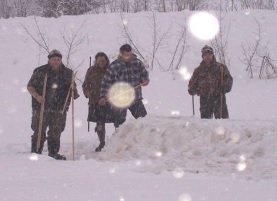
The Snow snake launch platform
In this short introduction, we have attempted to share some of our experience with making and playing with the Wabanaki snowsnake game. In the old days competition was fierce, and wagering even accompanied some games. We are hoping that a revival of the Tsoheac will spread throughout the old Wabanaki homeland.
Frederick M. Wiseman, Ph D., is an Abenaki historian and Wampum Keeper enrolled in the Missisquoi Abenaki Tribe. After spending many years collecting original pieces of historic clothing he has become one of the co-curators of Alnobak: Wearing Our Heritage. He has researched and written books about Abenaki history and culture. He is esteemed by the community as one of the leading scholars in the field of Abenaki Studies.

